EXOR International Cybersecurity
Industrial cybersecurity
starts inside the machine
EXOR helps machine builders and system integrators design connected industrial technologies with secure devices, protected software environments and lifecycle-ready automation architectures.
Why it matters
Cybersecurity is becoming a design requirement
Industrial machines are no longer isolated assets. They are connected, updated, integrated with IT/OT networks and increasingly managed across their full operational life.
Exposure reduction
Limit unnecessary services, ports, protocols, and attack surfaces during the earliest architecture decisions.Access Control
Manage users, roles, sessions, authentication and permissions across HMI, and device environments.Integrity protection
Support software authenticity, project protection, secure update packages, and data protection.Lifecycle management
Address vulnerability management, updates, documentation, and long-term support as part of the product lifecycle.Why it matters
Cybersecurity is becoming a design requirement.
Industrial machines are no longer isolated assets. They are connected, updated, integrated with IT/OT networks and increasingly managed across their full operational life.
Reduce exposure
Limit unnecessary services, ports, protocols and access points from the earliest architecture decisions.Control access
Manage users, roles, sessions, authentication and permissions across HMI and device environments.Protect integrity
Support software authenticity, project protection, secure update packages and data protection.Manage lifecycle
Address vulnerability handling, updates, documentation and long-term support as part of the product lifecycle.Exor approach
Secure industrial technology, from hardware to software
EXOR integrates cybersecurity principles into industrial devices and software environments to help OEMs build secure machine architectures that are more secure, maintainable, and ready for evolving market expectations.
Secure device
foundation
Protected software
environment
Lifecycle-oriented
security
Key capabilities
Cybersecurity capabilities across EXOR technologies
A practical set of functions that supports secure machine design, controlled operation, and cybersecurity-oriented lifecycle management.
- Secure configuration by default
Security-oriented device settings, controlled services, and reduced exposure of unnecessary functions such as diagnostic services when not required. - Attack surface reduction
Firewall, NAT, port forwarding, whitelisting, and blacklisting features to help control traffic and reduce unnecessary access points. - User and role management
Granular permissions, user groups, password policies, session control, and runtime user management in HMI and software environments. - LDAP and enterprise authentication
Support for hybrid models with local and online users, connecting OT user roles with IT authentication infrastructures. - User and role management
Traceability of HMI operations such as tag writes, recipe management, alarm acknowledgements, login events, and critical parameter changes. - Data integrity and protection
Project signing, project encryption, signed update packages, and controls to protect software artifacts during distribution and execution. - Secure boot and data protection
Secure boot, signed applications, and encrypted data partitions for selected platforms and architecture classes. - Secure communication protocols
Support for HTTPS, FTPS, TLS, OPC UA security mechanisms, MQTT security, and protected data exchange.
Technology layers
A cybersecurity view of the EXOR technology stack
Hardware
BSB
JMOBILE
Lifecycle
Architecture
Standards, certificates and readiness
Competence is built through process, certification and continuous improvement
EXOR’s cybersecurity strategy is shaped by internationally recognized frameworks, secure development practices, and ongoing readiness activities for the evolving cybersecurity landscape.
- ISA/IEC 62443-4-1
Secure development lifecycle process for industrial automation and control systems. - ISA/IEC 62443-4-2
Technical security requirements roadmap for industrial components, embedded devices, and software applications. - BS EN 18031-1
Cybersecurity reference for radio-enabled products in the context of RED-DA conformity. - Lifecycle & disclosure
Product lifecycle statement, vulnerability disclosure policy, and security update management. - CRA, NIS2, Machinery Regulation
Readiness activities addressing product security, documentation, vulnerability management, supply chain, and machine safety expectations.
Use cases
Where cybersecurity becomes part of machine design
The value of EXOR cybersecurity capabilities becomes visible when OEMs need to deliver connected, service-ready, and lifecycle-managed machines.
Connected OEM machines
Radio-enabled
products
Remote support-ready equipment
Secure HMI applications
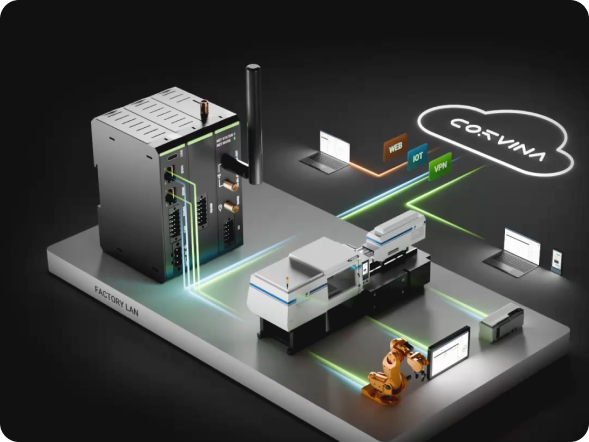
EXOR + CORVINA
Extend cybersecurity from the device to the connected asset
Documents, certificates and resources
A scalable area for cybersecurity documentation
Use this section as a future-ready resource center for certificates, policies, technical notes, security guidelines, webinar recordings, and customer-facing documents.
FAQ
Everything you should know
It means that cybersecurity is considered from the early stages of product development and reflected in architecture, configuration, access control, software integrity, communication, logging, and lifecycle management.
EXOR technologies support local firewall configuration, whitelisting and blacklisting, NAT, port forwarding and secure-by-default configurations to help limit unnecessary exposure.
JMobile supports user groups, granular permissions, password policies, LDAP integration, audit trail, project signing and encryption, digital signatures on critical tags and secure communication protocols.
Selected technologies support project signing and encryption, signed update packages, secure boot, signed applications and encrypted data partitions.
EXOR’s cybersecurity process is shaped by ISA/IEC 62443 principles, including the ISA/IEC 62443-4-1 secure development lifecycle and initiatives to achieve ISA/IEC 62443-4-2.
No single component can guarantee compliance for a complete machine. EXOR technologies support cybersecurity-oriented architectures and help OEMs address compliance-related processes within their broader machine design and validation activities.
Not yet. Exor International has started the ISA/IEC 62443-4-2 certification process and has formally committed to completing it within 2026. The effort is focused on i.MX8-based platforms. The certification already obtained is ISA/IEC 62443-4-1, which covers the secure development process. A formal statement of the 62443-4-2 commitment, signed by our CEO, is available on request through your Exor contact.
Only in part. Standard HMI products are outside the scope of the Machinery Regulation: an HMI is a communications component that does not perform actuation or energy-transformation functions, so it is not regarded as machinery or partly completed machinery, but as an electrical and electronic component without an independent safety function. Within our portfolio the Regulation applies to the hand-held HMI devices X5, X7 and X10, which contain safety-related elements. For those devices, full compliance with the cybersecurity requirements — protection against unauthorised access, assurance of software and firmware integrity, and secure update mechanisms — is confirmed by the mandatory application date of 20 January 2027.
EXOR | JMOBILE
Build cybersecurity into the HMI software layerBuild cybersecurity into your machine architecture
EXOR + CORVINA
Extend cybersecurity from the device to the connected asset