
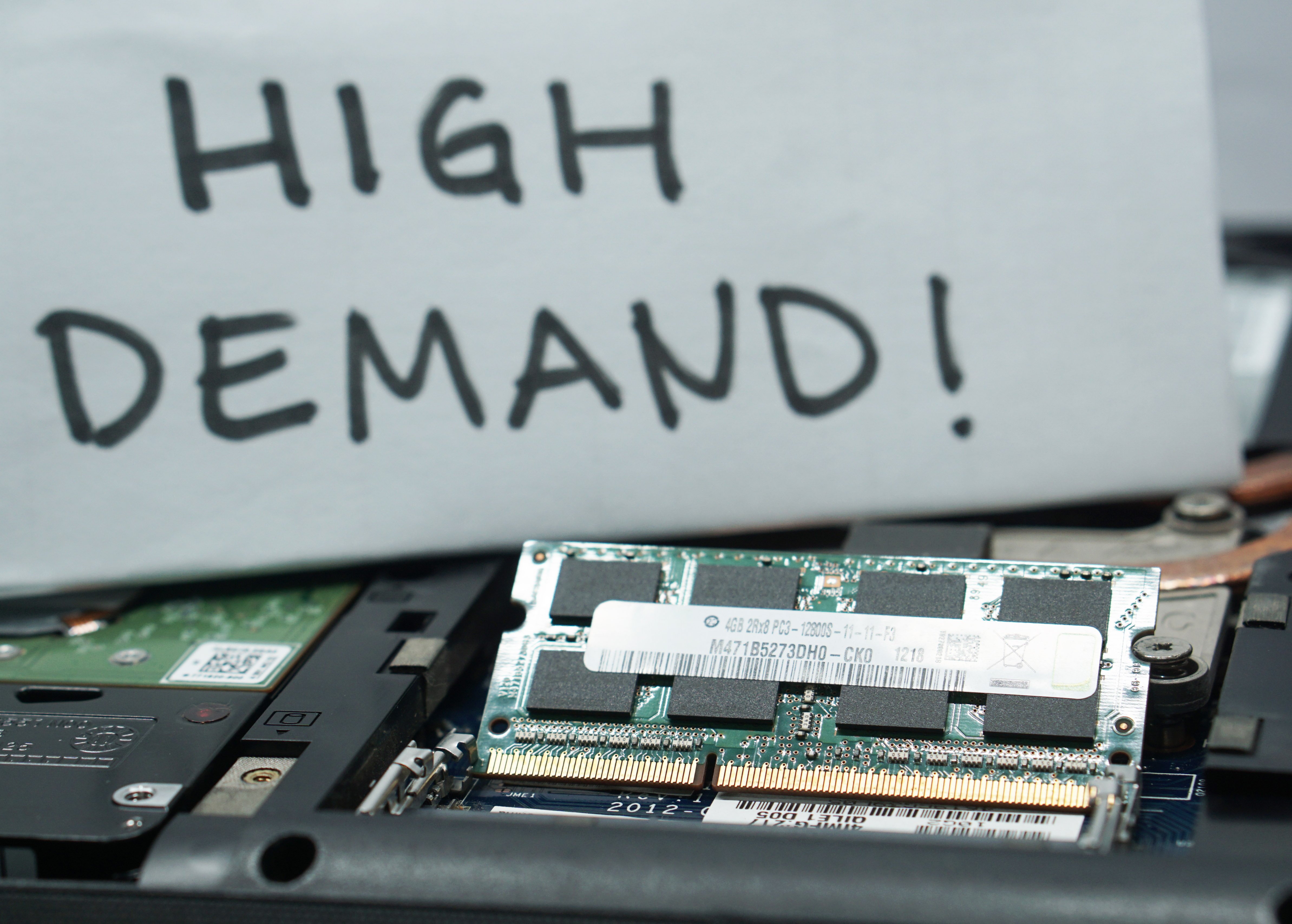
Over the past months, concerns around component availability have returned to the agenda of many OEMs and industrial manufacturers. Among them, memory shortages are once again raising questions, not only about procurement, but aboutlong-term system viability.
While the situation today is very different from the acute shortages experienced between2020 and 2022, the current market signals point to a more structural issue. The question is no longer if shortages may happen again, but how industrial systems are designed to cope with them.
Why is memory availability under pressure today
The renewed tension around memory components is not driven by a single disruption, but by a combination of structural trends.
A major factor is the rapid expansion of AI and high-performance computing,which is absorbing a growing share of global DRAM and NAND production capacity.According to Micron Technology and Samsung Electronics, a significant portion of new investments is now directed toward high-margin, high-bandwidth memory for data centers and AI accelerators rather than mature memory technologies traditionally used in industrial systems.
At the same time, memory manufacturers are progressively phasing out older production nodes. While this makes economic sense, it creates friction for industries that depend on long-term availability of qualified, stable components rather than cutting-edge performance.
As a result, the issue is not a general lack of memory, but a shortage of industrial-grade,long-lifecycle memory components.
Why industrial automation feels the impact more strongly
Industrial automation operates under constraints that differ fundamentally from consumer or IT markets.
Machines are designed, validated, and deployed with lifecycles that often exceed 10–15 years. Hardware changes, even seemingly minor ones, can trigger extensive requalification processes, software validation, and in some cases renewed safety or cybersecurity assessments.
This is why memory shortage are particularly disruptive in OT environments. They introduce uncertainty into systems that were historically designed for stability and predictability.
Industry analysts have highlighted this mismatch. According to Gartner, industrial organizations are increasingly exposed to supply chain volatility precisely because many OT architectures were not designed with component variability in mind.
In this context, availability issues quickly turn into architectural challenges, not just sourcing problems.
Memories shortage is a symptom of deeper design assumptions
When looked at more closely, memory shortage reveals long-standing assumptions in industrial system design.
For years, many architectures implicitly relied on:
• fixed hardware configurations,
• static resource allocation,
• tight coupling between software functionality and specific components.
These assumptions worked well in a stable supply chain environment, but today’s market dynamics expose their limits.
As McKinsey & Company notes, resilience in industrial systems increasingly depends on architectural flexibility rather than on optimizing individual components.
From availability concerns to resilience by design
What is emerging across the industry is a more mature way of framing the problem.
Instead of asking “How do we avoid shortages?”, leading OEMs are starting to ask:
“How do we design systems that remain viable when components change?”
This shift places emphasis on:
• modular architectures,
• decoupling software capabilities from fixed hardware assumptions,
• controlled scalability of resources,
• and lifecycle strategies that accommodate evolution rather than resist it.
In this sense, memory shortage act as a stress test. They highlight which systems can absorb change and which ones require costly redesigns when conditions shift.
What does this mean for OEMs and manufacturers
For OEMs, the implications go beyond procurement.
Long-term competitiveness increasingly depends on the ability to:
• manage component evolution without disrupting machine behavior,
• maintain cybersecurity and update processes despite hardware changes,
• support certified systems throughout extended lifecycles.
Memory availability is only an example, but it clearly illustrates a broader reality: industrial automation can no longer be designed on the assumption of permanent hardware stability.
Final thought
Memory shortage may appear, at first, as a supply chain concern, but in practice, they expose a design challenge.
As industrial automation enters a phase of sustained uncertainty, architecture matters more than individual components. Systems built with flexibility and long-term resilience in mind are better equipped to navigate these shifts without compromising reliability, security, or continuity.
The real question is no longer whether shortage will happen again, but whether industrial systems are ready when they do.


