
For many years, the cab display had a simple job: showing values and warnings coming from the vehicle controllers. Today, expectations are much higher. Machine builders want to differentiate their products through the user experience. Fleet owners want data about machine usage and productivity. Service teams want to diagnose problems without travelling to a remote job site. And operators expect the same intuitive interaction they enjoy on their smartphones.
This shift is turning the cab display into an edge device: a computer that not only visualizes data, but also collects it, processes it and makes it available beyond the cab. To play this role, an off-highway HMI needs adequate processing power, reliable local storage, flexible software, built-in connectivity and, above all, scalability.
Why Scalability Matters for Off-Highway Machine Builders
Scalability matters because machine builders rarely design a single machine. They design product ranges: a compact loader and a large harvester need very different screen sizes, and a main display has different requirements from an auxiliary display dedicated to a single implement. Managing different hardware platforms and different software tools for each machine multiplies engineering effort, testing and spare parts. A scalable family running the same software lets engineering teams reuse their know-how, graphics and logic across the entire range.
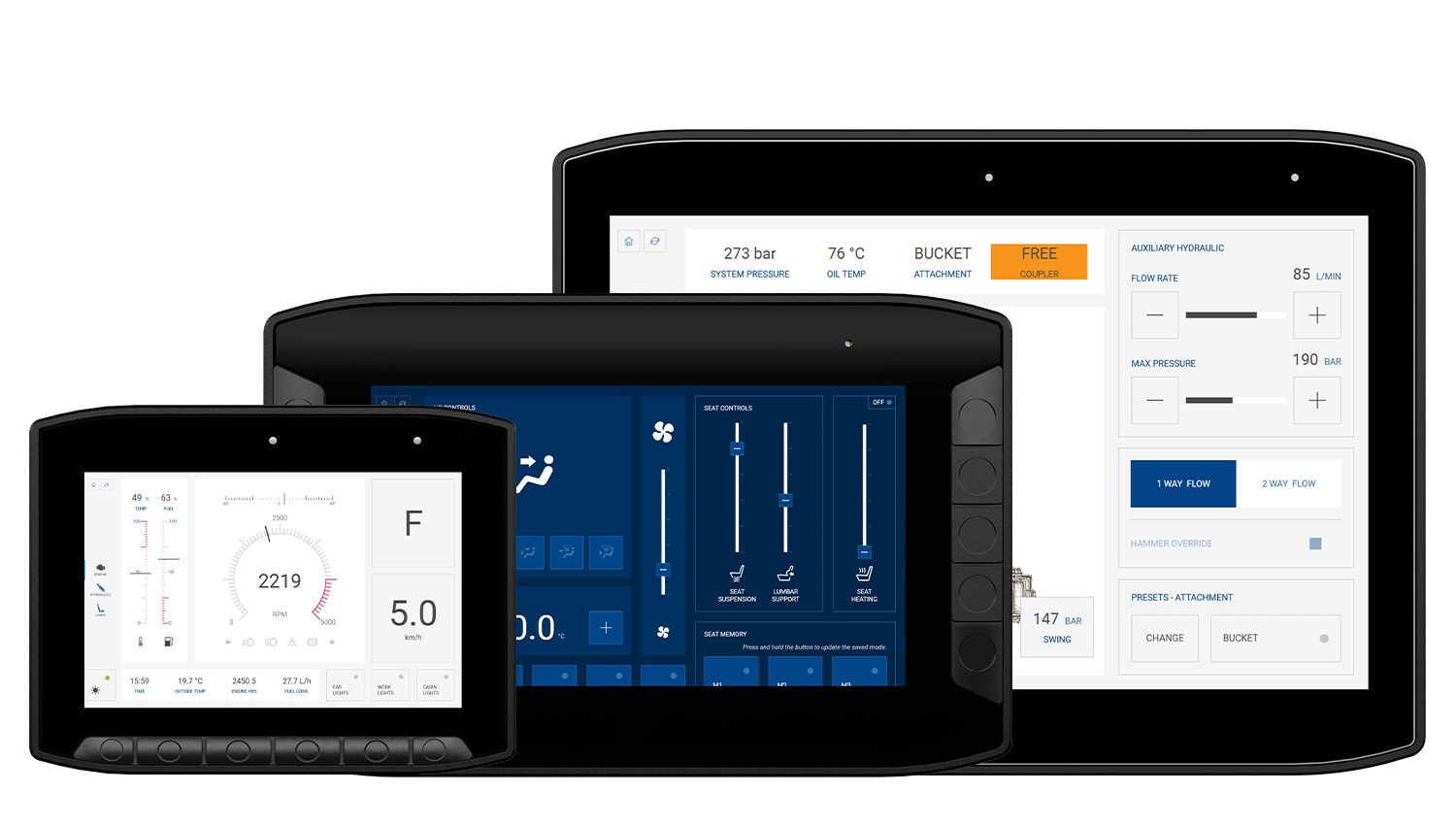
This is exactly the idea behind the new XA100 Series from EXOR International. Four display sizes, from 5" to 12", share the same rugged design and the same JMobile runtime. The XA105 and XA107 are based on a dual-core processor with 1 GB of RAM, ideal for compact machines and auxiliary functions, while the XA110 and XA112 step up to a 64-bit quad-core CPU with 2 GB of RAM for rich, high-resolution main displays. All models run a real-time Linux operating system and use 4 GB of eMMC pSLC flash memory for robust data storage, plus 64 KB of FRAM to safely retain critical data.
On the software side, the JMobile runtime enables customizable user interfaces, data logging and remote access, while multiprotocol support allows the display to communicate with both mobile and industrial devices. Machine builders can design branded, intuitive interfaces, record working data and alarms, and give their service teams remote access to the machine whenever it is needed.
Beyond Visualization: Connectivity, Data and Edge Intelligence
Connectivity is built in. Alongside the two isolated CAN interfaces, every XA100 display offers an Ethernet port, two USB ports, a serial port, four digital inputs and four digital outputs, and integrated Wi-Fi. This makes it possible to transfer data when the machine returns to the yard, connect to service tools, or integrate the display into a wider connected-machine architecture.
The XA100 Series is also machine-aware. Integrated temperature, 3-axis accelerometer and ambient light sensors provide the application with information about the environment: brightness can adapt between day and night operation, and acceleration data can be used by the application to monitor machine movements and shocks. Finally, an expansion slot (two on the XA112) is provided for plugin modules, so the platform can grow with future application needs.
More details will be revealed during the official launch webinar, but one message is already clear: the XA100 Series is not just a rugged display, it is a scalable, connected platform for the next generation of mobile machines.

As off-highway vehicles become increasingly digital, the right HMI platform can make the difference between a machine that simply works and a machine that delivers data, value and a better experience to everyone who uses it. With the XA100 Series, EXOR brings its expertise in HMI software and connectivity to the world of mobile machines.


