
Industrial automation has never been static. It has progressed in waves, each driven by new technologies, new expectations, and new ways of thinking about machines and data. What once began with isolated equipment has gradually transformed into an ecosystem where connectivity, intelligence, and services define competitiveness.
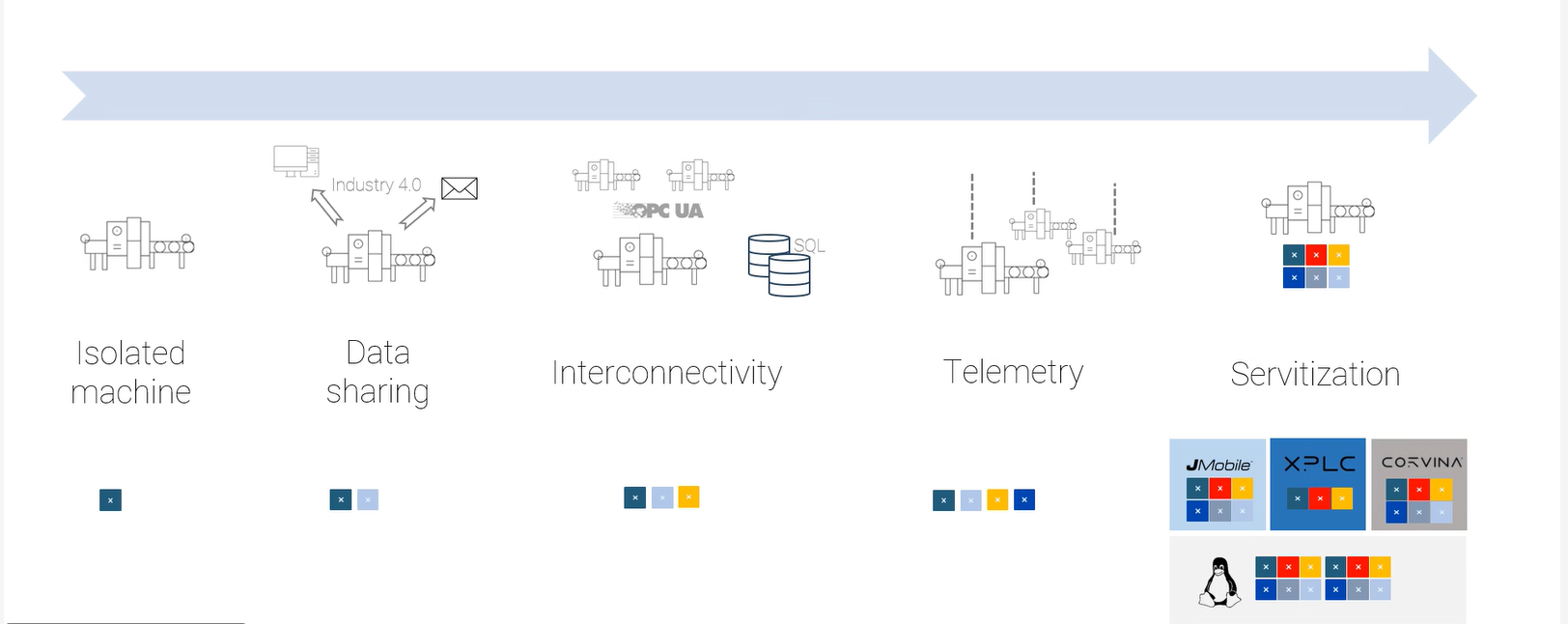
At Exor International, we often describe this transformation as the Path of Industrial Automation: a journey that many OEMs and manufacturers are still navigating, each at their own pace.
And it is along this path that the X Platform was intentionally designed to evolve.
From isolated machines to the first digital links
For many years, machines stood alone. They performed their tasks reliably, but everything remained local: the logic, the data, and the operator interaction. In this phase, the goal was simple, make the machine work, and make it easy for people to control it.
Exor International’s early HMIs were built exactly for this purpose: robust, intuitive, and dependable, supported by JMobile, an intuitive framework designed to simplify interface development and ensure consistency over time.
But as the first waves of digital transformation spread through industry, things began to change. Production lines needed to share information with supervisory systems. Data stopped being something that lived inside a machine and became something that needed to move to other machines, to dashboards, to IT systems.
It was the beginning of data sharing and the first step toward Industry 4.0.
Interconnectivity: when machines start speaking the same language
Interconnectivity marks a decisive step in the evolution of industrial automation. It is the point where machines stop being individual assets and start operating as part of a coordinated system.
In the early stages of digitalization, connectivity was often implemented through point-to-point links: a machine connected to a supervisor, a PLC to an HMI, and a gateway to a server. While functional, these architectures were difficult to scale and heavily dependent on proprietary integrations.
As industrial environments grew more complex, this approach proved insufficient. True interconnectivity requires standardization and interoperability, allowing machines, systems, and applications to exchange data reliably across vendors and layers. This shift has been enabled by open standards such as OPC UA and MQTT, designed to decouple data exchange from specific hardware and ensure secure, vendor-neutral communication. According to the OPC Foundation, OPC UA has become a cornerstone of modern automation architectures precisely for this reason.
Industry analysts also point out that connectivity alone is no longer the goal. Gartner notes that industrial organizations increasingly view connectivity as a prerequisite for higher-value capabilities, such as advanced analytics, predictive maintenance, and autonomous operations at the edge.
At this stage, automation evolves from connected devices into a distributed system, where control, data processing, and decision-making can occur at different levels, machine, edge, or cloud, depending on operational needs.
This is also where integrated control plays a key role. Technologies such as XPLC enable deterministic control to coexist with data processing at the edge, supporting modern architectures without disrupting established machine behavior.
Interconnectivity, therefore, is not a feature, but the foundation that makes modern industrial automation possible.
Telemetry: understanding machines in motion
Once connectivity is established, organizations naturally want more visibility. They want to understand not only what is happening, but why, and ideally before something goes wrong.
This is where telemetry becomes essential.
Streaming data to the cloud or edge dashboards enables faster troubleshooting, performance optimization, energy analysis, and even predictive behaviors.
With the arrival of Corvina, our group made it possible to connect fleets of machines securely, visualize their performance, and maintain them remotely, whether a machine sits in a single factory or is deployed worldwide.
At the same time, JMobile and XPLC ensure that interface behavior and control execution remain closely aligned at the edge, allowing usability and performance to evolve together.
Telemetry marks the moment when digital capabilities stop being an add-on and start becoming a strategic asset.
Servitization: when machines become services
The most advanced stage of industrial automation is servitization: a shift in which machines are no longer delivered as standalone products, but as continuously evolving services.
OEMs increasingly move toward models based on uptime, performance, remote support, predictive maintenance, or pay-per-use. Manufacturers, in turn, expect equipment that can be monitored, updated, and optimized throughout its entire lifecycle, often remotely and at scale.
This transformation fundamentally changes the role of connectivity. Machines are no longer connected only for visibility, but for ongoing interaction: software updates, configuration changes, diagnostics, and data-driven services become part of daily operations.
At this point, cybersecurity stops being a technical requirement and becomes a business requirement.
Remote access, cloud integration, and fleet-wide management significantly expand the attack surface. Regulatory frameworks such as IEC 62443, NIS2, and the Cyber Resilience Act (CRA) reflect this reality, placing increasing responsibility on machine builders to design security into both products and services.
Servitization therefore demands architectures that are not only connected and scalable, but also cybersecure by design, capable of managing identities, access rights, updates, and vulnerabilities over time. Without this foundation, service-based models simply do not scale in a sustainable way.
In this sense, cybersecurity is not an additional layer of servitization.
It is what makes servitization viable.

The X Platform: a unified evolution, not a collection of tools
When we speak of the X Platform, we are not referring to a single product or a technological layer.
The X Platform represents the way Exor International has chosen to evolve alongside the industry: a coherent, integrated environment designed to support every stage of automation, from local control to global intelligence.
It is the natural outcome of years spent building technologies that are compatible with one another, that speak the same language, and that grow in capability as the needs of OEMs and manufacturers grow, from intuitive interface design with JMobile, to integrated control execution through XPLC, to cloud-enabled intelligence with Corvina. Instead of forcing customers to adopt disconnected solutions as they move from visualization to edge processing, to cloud insights, the X Platform allows this transition to happen within one continuous technological journey.
This is why we describe it not as a product stack, but as an industrial architecture: something that accompanies the machine from the moment it is conceived, through its commissioning, its operation, its servicing, and eventually its evolution into a service-driven asset.
In other words, the X Platform is the expression of a principle: automation should grow, not be rebuilt.
Final thought
The Path of Industrial Automation shows how far the industry has come, from isolated machines to interconnected ecosystems and service-driven models. Each step adds complexity, but also opportunity.
The X Platform stands precisely at this intersection. Not as a tool to be adopted, but as a framework to grow into. Not as a product to be learned, but as an architecture that adapts to the maturity of the customer.
It ensures that whether a company is starting from local HMI interaction or moving toward fleet-wide remote services, the evolution remains coherent, secure, and future-ready.
With the X Platform, OEMs and manufacturers can move confidently along their own automation path, one step at a time, without ever having to start over.


